
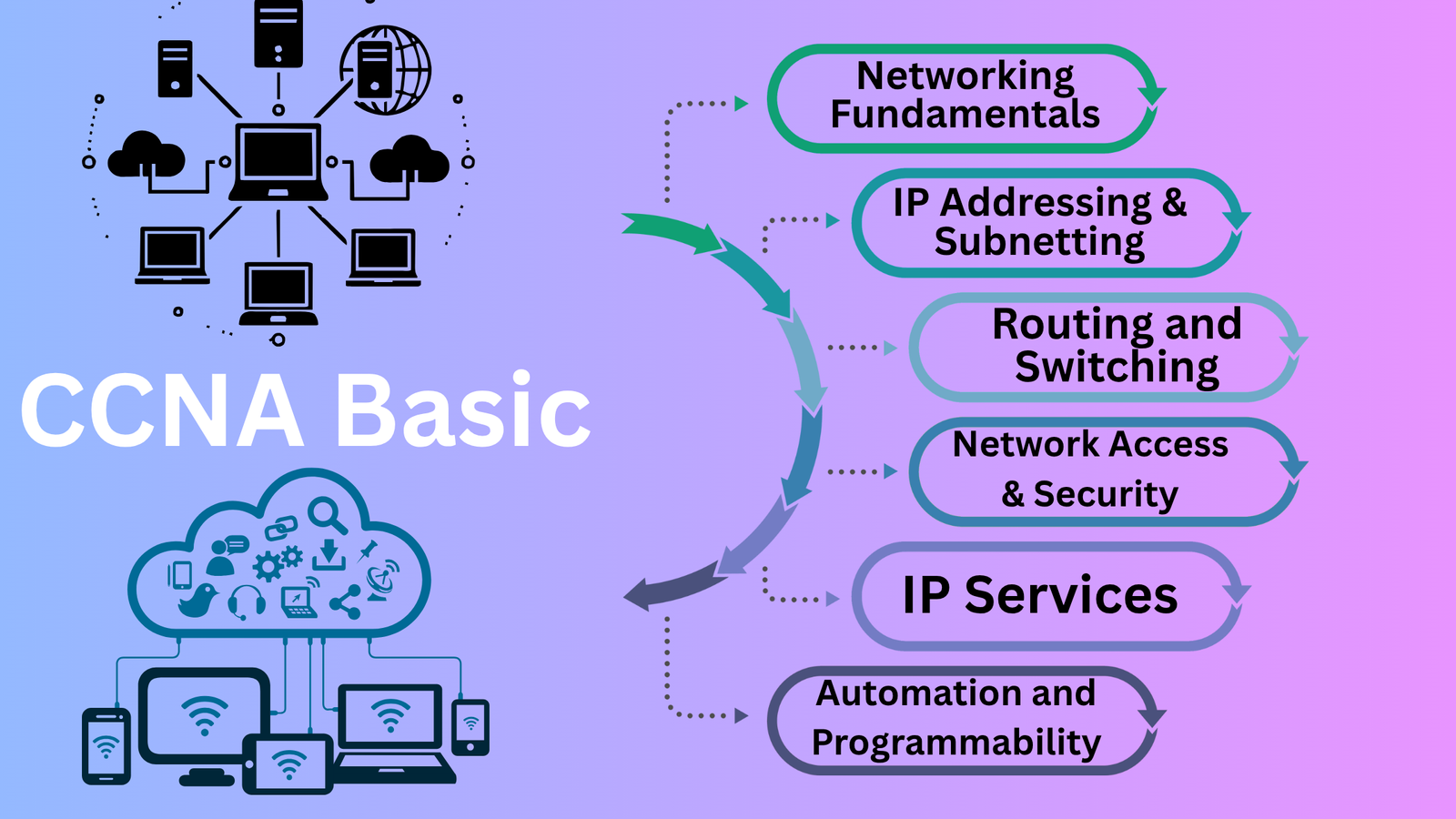
CCNA BASIC
- Categories Networking: CCNA
- Date September 21, 2025
- Comments 2 comments
CCNA BASIC : Beginning of Networking
In today’s hyper-connected world, networks form the backbone of nearly every digital experience we have. Whether you’re scrolling through social media, sending an email, or attending a Zoom meeting, computer networks make it all possible. If you’ve ever wondered how this digital magic works, CCNA Basics: Your First Step into the World of Networking is exactly where you should begin.
Understanding how devices connect and communicate is more than just a tech curiosity—it’s a career path. The CCNA (Cisco Certified Network Associate) certification provides a gateway into this fascinating field. In this guide, we’ll explore the fundamentals of CCNA, why it’s important, and what you’ll learn on your journey into networking.
What is CCNA?
At the heart of CCNA Basics: Your First Step into the World of Networking is the idea that everyone can understand networks if they’re taught properly. CCNA is an entry-level certification offered by Cisco Systems, one of the biggest names in IT and networking worldwide.
CCNA certification validates your ability to install, configure, operate, and troubleshoot medium-sized routed and switched networks. It’s designed for beginners but lays a rock-solid foundation that can lead to more advanced certifications and career opportunities.
Why Choose CCNA?
There are many reasons to start your networking journey with CCNA. Here’s why CCNA Basics: Your First Step into the World of Networking makes sense for aspiring IT professionals:
-
Foundational Knowledge: Learn the core principles of networking step-by-step and radio networking like 5G.
-
Career Launcher: Opens doors to roles like network technician, junior network admin, or helpdesk engineer.
-
Hands-On Learning: CCNA includes practical, real-world scenarios using routers, switches, and networking tools.
-
Globally Recognized: Cisco is a respected name in IT, and its certifications carry weight in job markets around the world.
What You’ll Learn: Key Topics in CCNA
A big part of CCNA Basics: Your First Step into the World of Networking is getting familiar with the wide range of topics covered in the certification. These include:
1. Networking Fundamentals
-
OSI & TCP/IP models
-
Network topologies (Star, Mesh, Bus)
-
LAN, WAN, and MAN networks
-
Cables, switches, routers, and access points
2. IP Addressing & Subnetting
-
IPv4 & IPv6 fundamentals
-
Subnetting and supernetting
-
CIDR notation
-
Public vs private IPs
3. Routing and Switching
-
Static and dynamic routing (RIP, OSPF, EIGRP)
-
VLANs and trunking
-
STP (Spanning Tree Protocol)
-
EtherChannel and inter-VLAN routing
4. Network Access & Security
-
Port security & access control lists (ACLs)
-
Wireless basics and WPA/WEP
-
Basic firewall and VPN concepts
5. IP Services
-
DHCP and DNS
-
NAT (Network Address Translation)
-
NTP and SNMP (optional for deeper study)
6. Automation and Programmability
-
SDN (Software Defined Networking) basics
-
REST APIs and JSON for network configuration
-
Intro to Python in networking (optional but useful)
Hands-On Practice: Learning by Doing
One of the best parts of CCNA Basics: Your First Step into the World of Networking is how much emphasis it places on real-world experience. You’re not just reading theory—you’re applying what you learn using tools like:
-
Cisco Packet Tracer – A free simulator for building virtual networks
-
GNS3 or EVE-NG – More advanced simulation tools for virtual labs
-
Real Cisco Devices – If you have access to actual routers and switches
These tools help you experiment, troubleshoot, and build confidence, which is critical both for passing the exam and working in real IT environments.
Exam Details
The current version of the CCNA certification is known as Cisco Exam Code: 200-301. Here’s what you need to know:
-
Duration: 120 minutes
-
Format: Multiple-choice, drag-and-drop, simulations, and lab-based questions
-
Cost: Around $300 USD (can vary by country)
-
Topics: Covers everything we’ve outlined so far
With CCNA Basics: Your First Step into the World of Networking, you’ll be fully prepared for both the technical and test-taking challenges ahead.
Who Should Start with CCNA?
The great thing about CCNA Basics: Your First Step into the World of Networking is that it’s suitable for a wide audience:
-
Students or recent graduates in IT or Computer Science
-
IT support and helpdesk professionals
-
Network technicians or aspiring sysadmins
-
Self-learners and tech enthusiasts
No matter your background, if you’re curious about how networks function, CCNA is the ideal entry point.
What Comes After CCNA?
Once you complete your CCNA journey, what’s next? Fortunately, Cisco offers a clear path forward. After CCNA Basics: Your First Step into the World of Networking, consider these options:
-
CCNP (Cisco Certified Network Professional) – Focused on more advanced routing and switching
-
Cisco CyberOps Associate – Dive into security and cybersecurity operations
-
Cisco DevNet Associate – Explore automation, coding, and network programmability
Each of these paths can help you specialize in a particular area of IT and grow your career.

You may also like

2 Comments