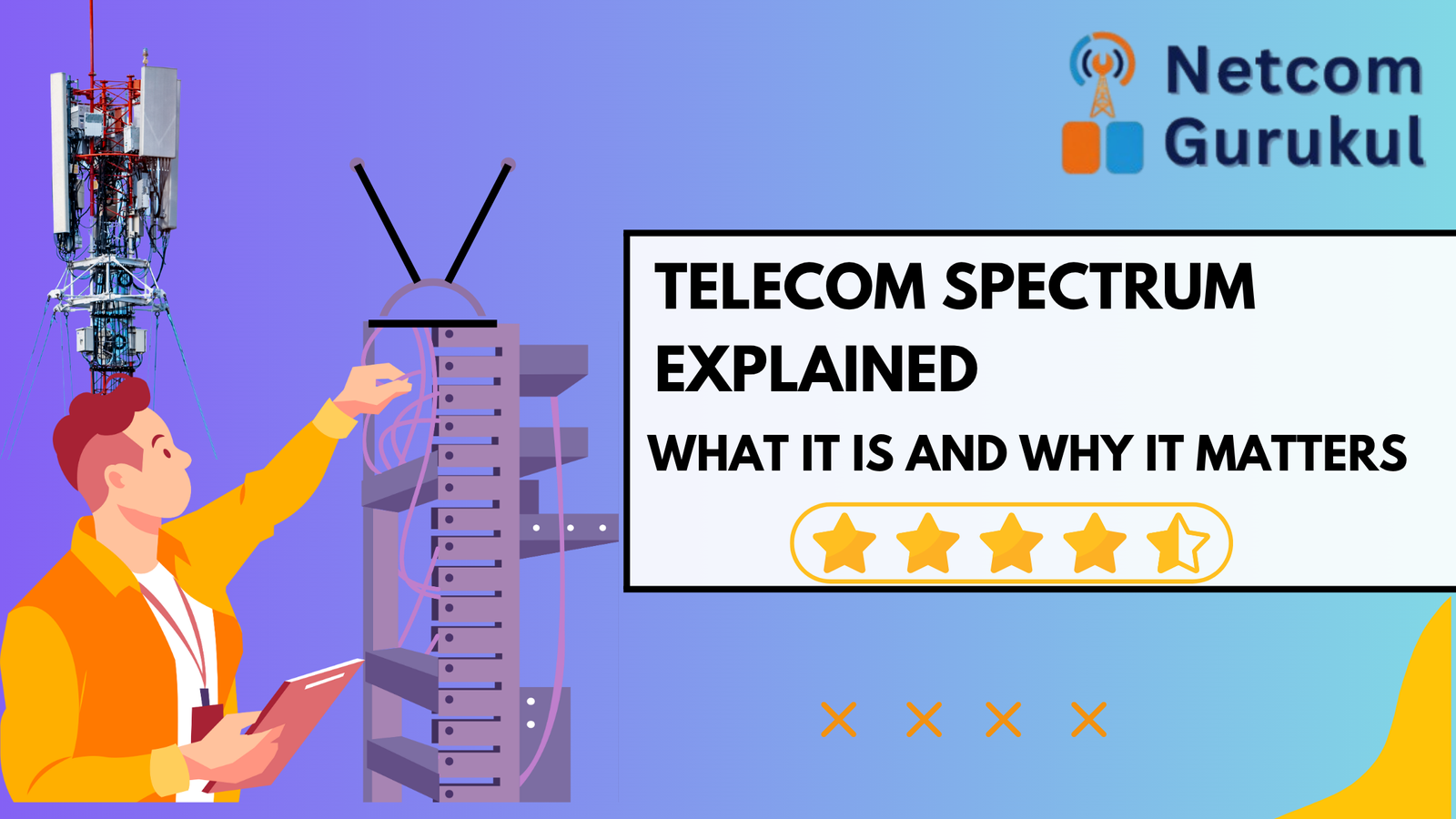
What is Spectrum in Telecom?
Telecom Spectrum Explained:
In today’s hyper-connected world, mobile phones, internet services, and wireless communications are the backbone of modern life. But have you ever wondered how your voice travels during a phone call, or how your video loads in seconds—all without a single wire? The answer lies in something invisible yet essential: the telecom spectrum.
This blog—Telecom Spectrum Explained: What It Is and Why It Matters—will take you through the fundamentals of the spectrum, its role in wireless communication, and why it’s one of the most valuable assets in the telecom industry.
Understanding the Telecom Spectrum
Telecom Spectrum Explained: begins with understanding what spectrum actually means in telecommunications.
The telecom spectrum refers to the range of electromagnetic radio frequencies used to transmit voice, data, and video over the air. These frequencies are the foundation for all wireless communication, including mobile phones, Wi-Fi, satellite communication, television broadcasting, and even public safety networks.
Telecom services primarily operate within the radio frequency (RF) portion of the electromagnetic spectrum—ranging from 3 kHz to 300 GHz.
Why Is Spectrum Important?
In Telecom Spectrum Explained we liken spectrum to real estate in the sky. Just as roads are necessary for vehicles, spectrum is essential for wireless communication. Different frequency bands are like separate traffic lanes, each assigned to a specific type of communication or telecom provider to prevent interference.
Here’s how different bands function:
-
Low-band spectrum (below 1 GHz): Offers wider coverage and excellent indoor penetration—ideal for rural or remote areas.
-
Mid-band spectrum (1–6 GHz): Balances speed and coverage—widely used in urban mobile networks.
-
High-band spectrum (above 24 GHz), also called millimeter wave (mmWave): Delivers ultra-fast speeds but limited coverage—perfect for dense urban zones and hotspot areas.
How Is Spectrum Managed?
Since spectrum is limited and extremely valuable, governments regulate its allocation. National regulatory authorities—like the FCC (USA) or TRAI (India)—oversee spectrum management. They allocate frequencies via auctions or administrative licensing, depending on regional policies.
Mobile operators bid for specific spectrum bands needed to operate networks like 3G, 4G, and 5G. These licenses typically last for several years and come with specific usage guidelines.
One of the key lessons in Telecom Spectrum Explained: What It Is and Why It Matters is that spectrum management determines everything from call quality to internet speed.
Spectrum and 5G: A New Era
5G has revolutionized how we think about wireless networks—and spectrum is at the heart of it. To meet the high-speed, low-latency demands of 5G, operators need access to a broader range of spectrum bands, often across low, mid, and high frequencies.
Telecom Spectrum Explained: What It Is and Why It Matters highlights how governments worldwide are repurposing and releasing new spectrum bands to fuel 5G deployment. This shift is enabling innovations in IoT, AR/VR, autonomous vehicles, and remote healthcare.
Licensed vs. Unlicensed Spectrum
Not all spectrum requires a license. Licensed spectrum is reserved for telecom operators who pay for exclusive access, while unlicensed spectrum is open to anyone—provided devices meet specific technical standards.
Popular technologies like Wi-Fi, Bluetooth, and Zigbee operate on unlicensed bands. This promotes innovation, especially for home networking and consumer electronics.
In Telecom Spectrum Explained: What It Is and Why It Matters, we note that both types of spectrum—licensed and unlicensed—are essential for a balanced, high-performing wireless ecosystem.
Spectrum Support by Industry Leaders
To understand how different parts of the spectrum are used, let’s look at leading vendors:
Nokia’s Spectrum Focus:
-
Low-band: 600 MHz, 700 MHz – wide coverage and rural reach.
-
Mid-band: 2.3 GHz, 2.6 GHz, 3.3–4.2 GHz, 6 GHz – strong balance of speed and reach.
-
High-band/mmWave: 26 GHz, 28 GHz, 40 GHz – ideal for ultra-dense urban areas.
Case examples:
-
Trial with Taiwan Mobile using 700 MHz (Band n28) + 3500 MHz (Band n78) for 5G SA.
-
Deployed 1900 MHz 5G radio for railway communications in Germany (FRMCS for Deutsche Bahn).
Ericsson’s Spectrum Focus:
-
Low-band: 450 MHz, 600 MHz, 700 MHz – essential for rural IoT and broad coverage.
-
Mid-band: 2.6 GHz, 3.3–4.2 GHz, 4.4–5 GHz – the backbone of 5G rollouts.
-
High-band: 26 GHz / 28 GHz mmWave – used for ultra-fast, short-range 5G.
These examples show how spectrum strategies differ between vendors and regions—key insight in Telecom Spectrum Explained: What It Is and Why It Matters.
Future of Spectrum Management
As wireless usage explodes, smarter spectrum use becomes essential. Expect growth in:
-
Dynamic Spectrum Sharing (DSS) – using the same band for 4G and 5G.
-
AI-driven network optimization
-
Spectrum sharing between public and private networks
-
Satellite-based spectrum for global internet coverage
In the future, as covered in Telecom Spectrum Explained: What It Is and Why It Matters, spectrum won’t just be allocated—it will be intelligently managed in real-time.
More Blog
- https://netcomgurukul.com/sim-vs-esim-card-key-differences-explained/
- https://netcomgurukul.com/5g-core-network-speed-benefits-impact-2026/
- https://netcomgurukul.com/ccna-basic/
- https://netcomgurukul.com/evolution-of-mobile-networks-2g-to-6g-timeline/
- https://netcomgurukul.com/how-to-be-a-modern-telecom-engineer/

You may also like
2G vs 3G vs 4G vs 5G: Key Differences Explained
SIM vs eSIM Card: Key Differences Explained